Rooted and Reaching Outward: How Bodington's Grassroots Heritage Movement Became a Model for Others
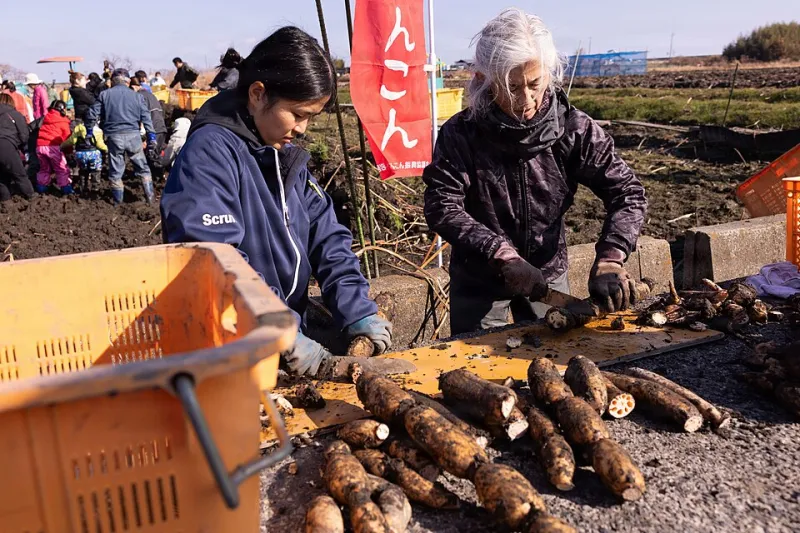
Photo: U.S. Marine Corps photo by Lance Cpl. Ella Cadby, Public domain, via Wikimedia Commons
Civic engagement, we are frequently told, is in decline. Voter turnout falls, local organisations struggle to attract volunteers, and the bonds that once tied communities to their shared history appear to fray with each passing decade. Against this backdrop, what has been happening in Bodington over the past several years looks, frankly, anomalous.
Here, a constellation of resident-led initiatives — some formal, some entirely informal — has produced something that no single institution could have engineered from above: a living, self-sustaining culture of heritage activism that is simultaneously looking inward at Bodington's own story and outward at what that story might mean for others.
How It Began
Origins are always more complicated than the stories told about them, but most observers trace the current moment to a handful of modest, overlapping efforts that gathered pace roughly a decade ago. A local history group began systematically recording the oral testimonies of elderly residents. A small band of volunteers undertook a comprehensive photographic survey of Bodington's built environment. A community archive, long underfunded and undervisited, was revitalised through a combination of crowdfunded digitisation and renewed public interest.
None of these initiatives was especially novel in isolation. What distinguished them was the way they reinforced one another — and the degree to which they were led, not by professionals or public bodies, but by people with no formal heritage qualifications and everything to gain from understanding where they came from.
"We weren't trying to build a movement," admits Ruth Cavendish, one of the founding members of the oral history project. "We were just trying to make sure that certain voices weren't lost. But once people started hearing the recordings, once they started seeing old photographs of streets they'd grown up in, something shifted. People wanted to be involved. They wanted to contribute their own memories, their own documents, their own photographs."
The Power of Participatory Documentation
What emerged from this groundswell was, in effect, a distributed archive — not housed in a single building, but spread across kitchen tables, community centres, and digital repositories maintained by volunteers. Residents contributed letters, diaries, trade directories, and family photographs. Schoolchildren conducted interviews with grandparents. Local businesses opened their storage rooms to researchers.
This participatory approach to documentation has several distinct advantages over more conventional archival practice. It is, first and foremost, far more comprehensive. Professional historians and archivists, however diligent, cannot be everywhere at once; a community-wide effort can capture material that would otherwise never enter the public record. It is also more democratic: the stories that emerge are not filtered through the priorities of a single institution, but reflect the full breadth of community experience — including voices that institutional heritage has historically marginalised.
Dr. Priya Nair, a heritage studies researcher at a northern university who has been observing Bodington's activities with considerable interest, identifies this as the movement's most significant contribution. "Traditional heritage practice has tended to privilege certain kinds of stories — the grand, the monumental, the officially significant," she observes. "What Bodington has done is insist on the value of the everyday, the domestic, the working-class, the migrant experience. That is not a minor adjustment; it is a fundamental reorientation of what local history is for."
From Documentation to Advocacy
The movement's reach has not been confined to archival work. The same networks that grew up around oral history recording and photographic surveys have repeatedly mobilised in defence of specific buildings, landscapes, and community spaces under threat. When a proposal emerged to demolish a Victorian terrace of particular historical significance, it was the heritage network — armed with documentary evidence, community testimony, and a clear articulate case — that mounted the most effective opposition.
"Having the history at your fingertips changes the nature of the argument," says community campaigner Owen Battersby, who coordinated that particular effort. "You're not just saying 'we like this building' or 'it feels important'. You're saying: here is what happened in this building, here are the people who lived and worked here, here is why this matters to the wider story of the town. That's a much harder case to dismiss."
The success of such campaigns has not gone unnoticed beyond Bodington's boundaries. Representatives from community groups in several other Yorkshire and Lancashire towns have visited to understand how the model works in practice. What they encounter is not a blueprint so much as a set of principles: start with listening, build trust before building databases, and ensure that the people whose stories are being told retain ownership of those stories.
What Other Communities Are Taking Away
The interest from elsewhere is both flattering and, for some in Bodington, slightly discomfiting. There is a wariness, among those most closely involved, of the movement being packaged into a transferable formula and losing the particular qualities that have made it effective here.
"What works in Bodington works partly because of Bodington," Cavendish reflects. "Our specific history, our specific mix of communities, the specific buildings and landscapes that people feel connected to. You can't simply transplant that. What you can transplant are the values: genuine respect for community knowledge, patience, a willingness to follow where the community leads rather than imposing an agenda."
Nair is somewhat less cautious. She believes that the structural lessons are genuinely portable, even if the specifics must always be locally adapted. "The key insight from Bodington is that heritage activism is most effective when it is genuinely bottom-up — when it emerges from community need rather than institutional initiative. That principle applies everywhere, even if the tactics must be tailored to each context."
A Responsibility That Belongs to All
Perhaps the most lasting contribution of Bodington's heritage movement is not any particular archive, campaign, or building saved, but a shift in how residents understand their relationship to the past. Heritage, in this community, has ceased to be something managed by others on the community's behalf. It has become, instead, a shared responsibility — and, more importantly, a shared pleasure.
At a time when so many forces conspire to make people feel powerless in the face of institutional decisions, there is something genuinely heartening about a community that has chosen to act rather than merely observe. Bodington has not solved the complex challenges facing local heritage across Britain. But it has demonstrated, with quiet conviction, that ordinary people equipped with curiosity, commitment, and a respect for evidence can shape the stories their communities tell about themselves.
That, in the end, may be the most valuable thing to export.