Rows of Small Cards, Decades of Curious Minds: What Bodington's Lost Library Catalogue Tells Us About Ourselves
A Discovery in a Forgotten Room
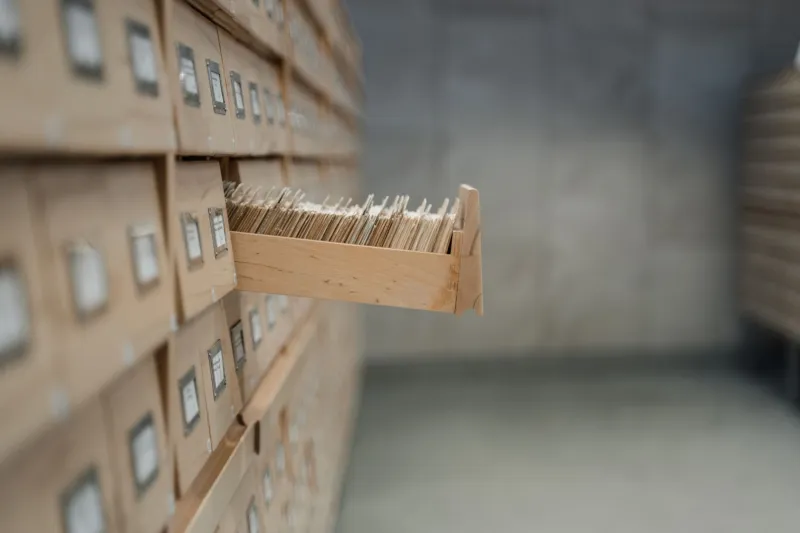
It arrived, as significant discoveries so often do in Bodington, without ceremony. During a routine clearance of storage space in the former municipal library building on Granger Street — a structure now serving a rather different civic function — a volunteer working with the Bodington Heritage documentation project encountered something that had been passed over for decades: a large oak cabinet, its brass-handled drawers swollen with age, containing the original card catalogue system used by the library from approximately the 1930s through to the early 1990s.
The cabinet itself was unremarkable to the untrained eye. Card catalogues of this type were standard issue across British public libraries for much of the twentieth century, the institutional backbone of a system that allowed borrowers to locate titles by author, subject, or classification number. When computerised databases rendered them obsolete, most were dismantled or discarded without a second thought. That Bodington's survived at all — some three thousand cards still held in near-complete sequence — is something approaching a minor miracle of institutional neglect.
What makes this particular catalogue worth examining, however, is not its physical survival alone. It is what the cards themselves contain: handwritten annotations, pencilled amendments, staff notes in the margins, subject headings that shift and evolve over the decades, and occasional slips of paper tucked between entries that speak to a library service adapting in real time to the needs of its community.
Reading the Cards as Social History
To spend an afternoon working through the catalogue's subject drawers is to receive an education in what Bodington once considered worth knowing. The headings are revelatory in their specificity. Under 'Agriculture — Local', one finds entries stretching back to titles that would have been considered practical rather than academic: handbooks on soil management, pamphlets on smallholding, guides to market gardening that reflect the semi-rural character of Bodington before the postwar decades reshaped the area's economy.
Elsewhere, the catalogue traces the town's engagement with broader national currents. A cluster of entries under 'Industrial Relations' bears the unmistakeable signs of heavy use — cards worn thin at their edges, the original ink supplemented by later additions in different hands — suggesting a readership that was not merely curious about the subject, but actively engaged with it. Similarly, the subject heading 'Housing — Rights and Legislation' contains a density of annotation that places it among the most-consulted sections of the catalogue's latter decades.
There is something quietly moving about reading these cards as evidence of intellectual appetite. These were not university researchers or professional scholars. They were, in the main, working people seeking information that bore directly upon their lives: tenants wanting to understand their legal position, workers trying to make sense of their entitlements, parents looking for guidance on child health or education. The library was, for them, a resource of genuine practical consequence.
The Librarians Behind the Cards
One of the most striking features of the catalogue is the degree to which it records individual human judgement. Subject headings were not assigned by algorithm; they were chosen by librarians who had to decide, card by card, how a given book ought to be classified and what cross-references might serve readers best. The consistency of certain handwriting styles across large sections of the catalogue suggests that particular members of staff were responsible for specific subject areas — a division of intellectual labour that is itself historically interesting.
A note tucked inside the drawer marked 'Local History — Bodington' reads, in a careful copperplate hand: 'See also: Photographs — Granger Collection (Box 4). Not catalogued. Ask at desk.' This small instruction, almost certainly written in the 1960s based on the style of the card stock, points to a broader informal system of knowledge management that operated alongside the formal catalogue — one in which the librarian's own memory served as a crucial supplement to the written record.
Such details remind us that the public library was never a passive repository. It was an active institution, shaped by the professional expertise and personal knowledge of those who staffed it. The card catalogue is, in this sense, as much a record of its curators as of its collections.
What Was Not Catalogued
Equally instructive is what the catalogue omits or marginalises. The headings assigned to material relating to women's lives outside the domestic sphere are sparse by modern standards; entries pertaining to communities that arrived in Bodington during the postwar decades are largely absent from the earlier sections of the catalogue, only appearing with any regularity in cards dating from the 1970s onwards. These absences are not incidental. They reflect the assumptions and limitations of the classification systems in use at the time — systems that were themselves products of particular cultural and institutional priorities.
Reading the catalogue with this critical awareness does not diminish its value as a historical document. Rather, it deepens it. The gaps are as informative as the entries, charting the slow, uneven process by which a public institution comes to recognise and serve the full breadth of its community.
The Question of Preservation
The discovery of the catalogue has prompted an important conversation within the Bodington Heritage project about what ought to happen next. The cards are fragile; the oak cabinet, though structurally sound, requires attention. Digitisation has been discussed, and there is a compelling case for it — a searchable, publicly accessible version of the catalogue would make its contents available to researchers, former borrowers, and anyone with an interest in the town's intellectual past.
Yet there are voices within the heritage community who argue, with some force, that digitisation alone is insufficient. The physical object carries information that no scan can fully capture: the texture of the card stock, the pressure of different hands in different eras, the faint pencil marks that speak of decisions reconsidered. A digital copy would be useful; the original is irreplaceable.
What is clear is that the catalogue cannot simply be returned to storage. It has already survived one era of institutional change by accident. Ensuring it survives the next will require intention.
A Record Worth Keeping
Bodington's card catalogue is not, on its face, a glamorous heritage find. It does not carry the drama of a cache of personal letters or the visual appeal of a collection of photographs. But it documents something that other sources rarely capture with such precision: the texture of ordinary intellectual life in a working community across six decades of change.
The questions Bodington's residents brought to their library — about their rights, their health, their history, their world — are as much a part of the town's story as its architecture or its industry. In the careful handwriting of long-retired librarians, in the worn edges of heavily consulted cards, in the subject headings that trace the shifting preoccupations of successive generations, there is a portrait of a community that was, above all else, curious.
That curiosity deserves to be remembered. The catalogue, for now, is its most faithful witness.